
Marked for Death: Substance Abuse Ignites a Public Health Crisis in Sierra Leone
By Morrison Saidu, Virginia, USA
As Sierra Leone contends with the severe and widespread problem of substance abuse, the youth are increasingly being pushed to their limits, thrusting their struggles into the spotlight of a long-overdue public health debate. Beyond the complex legal and political questions, the unfolding epidemic raises deep concerns about its social and economic toll on youth in a nation still struggling to regain lost public health gains and in an era of economic distress.
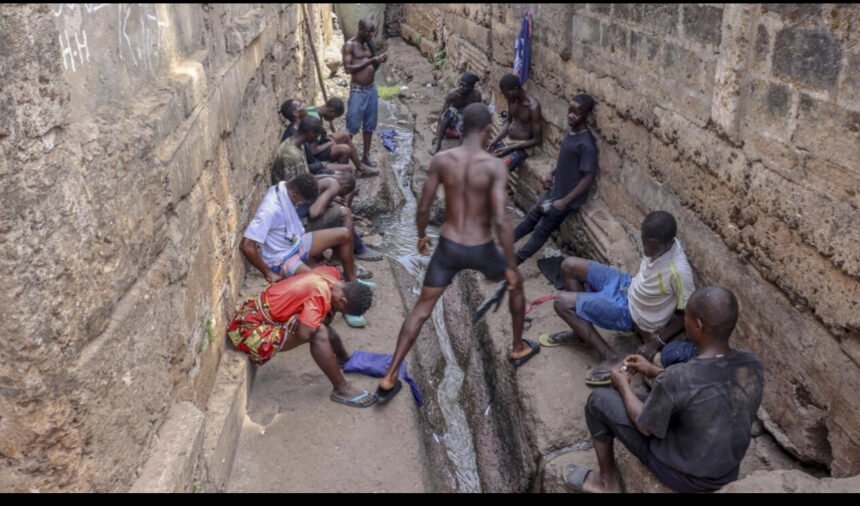
Our youth are smoking and sniffing their lives away, plunging into the darkest phases of their lives. It is not weed or cannabis; it is not fentanyl or cocaine. Called “Kush,” its chemistry is complex, often comprising a mix of opioids, cannabis, disinfectants, and, as local accounts have mentioned, pulverized human bones from graves. Unlike more commonly known substances like weed, cannabis, fentanyl, or cocaine, Kush’s consumption methods, sniffing and smoking, reveal the dark and dangerous ecosystem of its users and dealers, including a startling number of girls among the peddlers in the neighborhoods. After consumption, users exhibit symptoms characterized by dizziness, a loss of appetite, and a strong desire to sleep or rest. They are sometimes found lying in gutters, sewers, under bridges, or dumpsites, semi-conscious, hunched over, or with their feet pointing upwards and their heads resting against the ground. In Freetown, one youth described this state as an escape from hunger and the dreaded trials of urban youth life to a leisure zone.
Over recent months, there has been a worrying increase in the number of young people affected. Driven by the expansion of robust peddler networks, schools and universities continue to emerge as critical hotbeds in the Kush distribution chain. In Freetown and the rural municipalities, parents are witnessing the demise of their children, schools are expelling students, and youth are dying in front of their families. Recently, I spoke with some local partners in my home city, Bo, Southern Sierra Leone. They shared that the situation has deteriorated considerably. Boys in the neighborhood show up at doorsteps willing to undertake menial tasks such as disposing of garbage, meticulously cleaning entire compounds, and fetching five to ten jerry cans of water, all for about thirty new leones (SLE), approximately $0.0132 USD to buy a pack of Kush. Sadly, they are using income from their daily hustling, which could at least feed them a plate of rice from the street-side cookery, to buy Kush. The youth choose substance over sustenance, thus remaining underfed but under the influence of Kush for extended periods. These spectacles unfold openly on our streets, primarily involving young people who may not have a home or cannot stay in one.
Declaring the Kush problem a public health emergency and recognizing it as a national social concern, the government of Sierra Leone has established a task force, and through the Social Welfare Ministry, rehab centers have been set up. Some citizens are championing efforts to provide real-time intelligence on Kush, including information about dealers and trafficking networks. However, merely attributing solutions to these efforts oversimplifies the complex social and political realities of the Kush crisis, since only a limited number of users have accessed official rehab programs, and securing a spot, particularly for girls, remains a challenge. For long-term users trying to quit, the struggle is even more devastating, compounded by the scarcity of addiction treatment facilities and the inability of overstretched centers to provide adequate care.
The Kush epidemic is further complicated by the social and historical realities influencing the lives ofyoung people. Many are adrift, wandering the streets and graveyards, stripped of hope and still haunted by the traumas of growing up during and after the war, marked by deprivation and constant threat.
In this context, the lure of Kush with its false promise of escape becomes even more potent for those on the margins and for students, teachers, and young professionals who conceal their addiction.
Lacking supportive relationships and having often dropped out of school prematurely, these young people face a complex and usually painful passage into adulthood. The threats of insecurity and the denial of fundamental rights have pushed many distressed youths to make tough choices to survive, mainly through desperate means, often leading to drug abuse and crime. Some embarked on hazardous journeys to Europe aboard overcrowded fishing vessels, hoping for social safety and opportunity.
Unfortunately, most of these young adventurers neither reach Europe nor return home, leaving families in an endless search for their missing sons and daughters.
As the country faces harrowing images of young lives wasted on Kush, there is no doubt that the Kush problem is not just a public health crisis but a societal failure and a trend that reflects a troubling example of institutional decline. The sales and consumption have severely impacted a considerable portion of the developing youth population in our communities, pushing them almost to the “point of no return”. Kush is “consuming” fourteen, fifteen, and twelve-year-olds who are dying of overuse and overdose. Social media is awash with vile images of young talents curled up and drenched in gutters.
Some others sleep on the sidewalks and graves in cold and wet cemeteries in the city. Watching life shedding away from our youth is a grim sight.
Over the days, the country has witnessed a surge in unclaimed bodies on the streets of Freetown, with about 221 bodies as reported by local tabloids.
While many citizens have vigorously responded to the issue of Kush, advocating for domestic legislation that criminalizes drug use, there’s a pressing need for a fundamental shift in our perception of drug use among young people in communities and homes that have lost influence over their youth.
Using a youth-centric psychosocial support model to understand the plight of youth, both before and outside of their Kush use, is essential in developing effective interventions that can offer real hope and change for a generation at risk.
Increased drug abuse and addiction, crime, and the spiraling of partisan politics have become the order of the day. The sense of safety and community that once defined our upbringing is now under siege by a drug tsunami that threatens to erode the very bond of society that once provided a buffer against such threats. Young talents are entangled in a complex labyrinth, caught in the crossfire of the drug epidemic, striving to find their balance.
In Sierra Leone today, discussing a pertinent national issue often leads to accusations of dividing the country in two. For decades, the world has witnessed Sierra Leone’s painful trajectory with complex and protracted crises, from the twelve-year conflict to the
Ebola epidemic, the devastating mudslide, and the COVID-19 pandemic. In each of these moments, we also witnessed the courage and resilience of our citizens, as many risked their lives to save others.
Yet today, we are confronted with different dynamics. Without diminishing the heroic efforts of those working tirelessly on the ground, it is troubling that some Sierra Leoneans have chosen to capture a dying youth on their cell phone for political point scoring or create content for social media relevance instead of helping.
Equally concerning is that certain gargantuan social movements and local activists, once known for their boldness on national issues, have adopted a noticeably diplomatic and restrained approach to this unfolding crisis.
Citizens and other stakeholders have lamented that authorities may be chasing butterflies; as long as our markets remain flooded with Kush, there is no assurance that we can bring this unfolding epidemic under control with the urgency it demands. The youth and Kush crisis will go down in the annals of history as a test of our collective resolve. It challenges the government to lead with courage. It urges us, as citizens, to rise above apathy and decide whether we act together or continue to wallow in the cycle of blame.
The country is in a desperate race against time. Like the urgency seen in elections, there is a pressing need for a bipartisan situation room. This inclusive combined effort would mobilize and pull the substantial strengths and numbers of political parties from both spectrums, youth advocates, development partners, the media, community networks, corporate allies, and all invested stakeholders to dismantle the powerful networks and salvage our young and future voters from drug junkies to productive citizens.
This approach is not just an option; it is a moral imperative.