
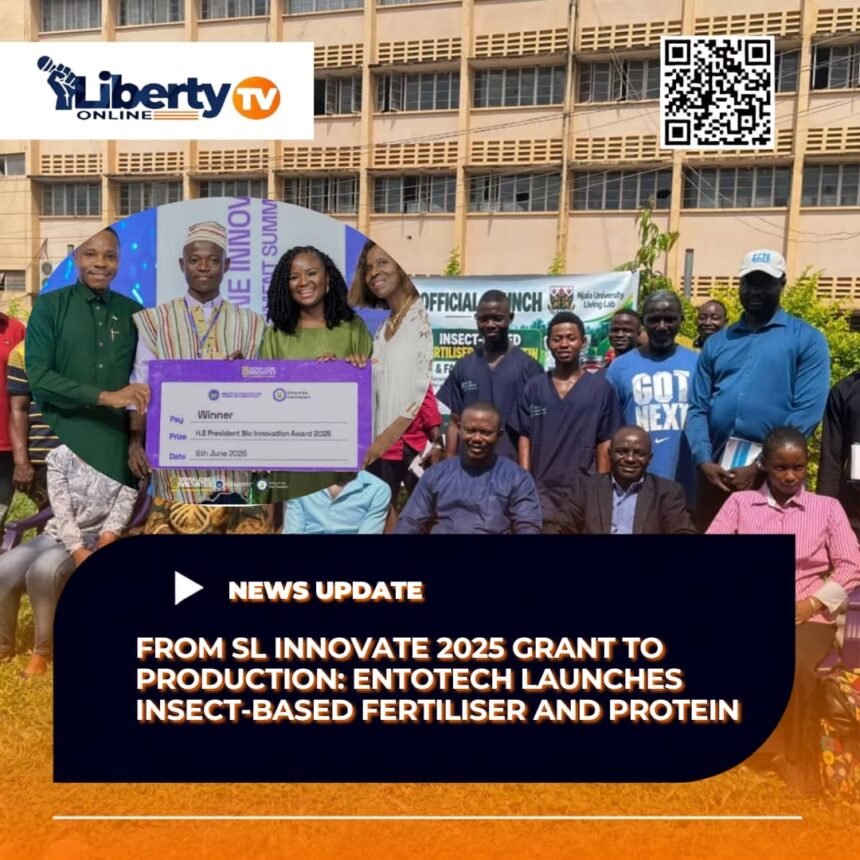
EntoTech Innovations has officially launched its insect-based organic fertiliser and protein products, marking a new phase in the company’s efforts to convert organic waste into agricultural inputs and affordable alternatives for livestock and aquaculture feed.
The launch, held at the Njala University Living Lab in Makonde, Taiama, brought together representatives from government ministries, farmers, development partners and other stakeholders interested in sustainable agriculture, innovation and the circular bioeconomy.
The initiative follows EntoTech’s success at the 2025 Sierra Leone Innovates (SL Innovates) programme, the flagship national initiative led by the Ministry of Communication, Technology and Innovation (MoCTI). EntoTech won the President Bio Innovation Award, receiving a US$30,000 grant to support the advancement and scaling of its insect-based solution.
Speaking at the event, EntoTech CEO Mohamed Samu explained how the company explored the potential of locally available organic waste, including cassava peels and other crop residues, for Black Soldier Fly production and the generation of organic fertiliser and protein.
Samu said cassava peel was among the waste materials tested because of its availability in Sierra Leone, alongside other agricultural by-products such as rice husks.
“We realised that cassava, being one of Sierra Leone’s leading crops, produces a lot of peel that goes to waste. We also understood that other crop waste, like rice husks, could be available. We did a standard laboratory trial and realised we could substitute Black Soldier Fly meal with 40 percent of cassava peel,” he said.
He said the results gave the company confidence to move towards larger-scale production, while further work was undertaken to establish a reliable supply of Black Soldier Flies throughout both the rainy and dry seasons.
According to Samu, EntoTech used the US$30,000 award to secure three acres of land at Four-Mile, which the company identified as a strategic location because of its proximity to poultry producers and the potential to meet growing market demand.
The company has since constructed what it describes as a standard insect-breeding facility measuring approximately 70 by 30 feet, which forms part of what EntoTech calls its Insect Village.
Samu said the company also developed additional infrastructure to attract Black Soldier Fly adults from the wild during the rainy season, while maintaining the insect population under controlled conditions during the dry season.
He said the company’s focus is now on sustainability and scaling production to meet farmers’ demand.
“We are very keen about sustainability. We are very keen about scaling. Can we scale this production to meet farmers’ demand? I want to tell you it is yes,” Samu said, adding that EntoTech has identified reliable sources of organic waste to support continued production.
At its Kambia facility, Samu said the company has produced about five tonnes of organic fertiliser, which is now ready for the market, as well as more than 300 kilograms of Black Soldier Fly protein that is being provided to farmers for testing and used in the company’s own trials.
He said the launch marks the beginning of the company’s commercial efforts to make the fertiliser available to farmers.
“Today is going to be the first day we are officially going to start selling our fertiliser,” Samu said, calling on development partners working with farmers and promoting climate-smart agriculture to support the distribution and uptake of the product.
The launch also drew support from government representatives.
Stevenson K. Kamanda, representing the Ministry of Communication, Technology and Innovation, said EntoTech’s work demonstrates how waste can be transformed into useful agricultural products.
“What makes EntoTech’s work particularly relevant is that it is looking at a practical challenge and asking a very important question: How can we turn something that is considered waste into something productive and valuable?” Kamanda said.
He said the company’s Black Soldier Fly technology is being used to convert organic waste into organic fertiliser and protein that can potentially be used in livestock and aquaculture feed.
Kamanda said the ministry remains committed to strengthening Sierra Leone’s innovation and entrepreneurship ecosystem and supporting promising innovators and enterprises.
Also speaking at the event, Musa Ngombuklah Kallon, Senior Conservator of Forest at the Ministry of Environment and Climate Change, highlighted the potential links between food production, environmental sustainability and public health.
Kallon said the project could contribute to efforts to improve food production by providing locally produced organic fertiliser and potentially more affordable feed options.
“Eighty percent of our health status is determined by our food intake. If you eat contaminated food, you get a result of that contamination,” Kallon said, adding that EntoTech’s work could support Sierra Leone’s efforts to become more self-sufficient in food production.
He described the initiative as an opportunity to support farmers through locally produced organic fertiliser and feed alternatives.
For farmers, the launch also provided an opportunity to share early experiences with the product.
Farmer Simeon Jusu, who mainly grows vegetables, said he had tested EntoTech’s organic fertiliser on his crops before its official launch. He said the results were particularly encouraging on his cucumber plants, which he described as developing well and producing fresh-looking crops.
Jusu encouraged other farmers to consider the organic fertiliser as an alternative to chemical fertilisers, which he said he believes can negatively affect crops when improperly used.
He said his experience with the insect-based fertiliser had given him confidence in its potential as a more natural option for crop production.
EntoTech says its broader objective is to create a circular system in which organic waste is transformed into useful agricultural products, while reducing waste, supporting healthier soils and providing alternative sources of protein for sustainable livestock and aquaculture production.
The company says further collaboration with government, development partners and farmers will be important to expand production, increase awareness and make the products more accessible to farmers across Sierra Leone.