
Development
Sierra Leone, DR Congo Push for Stronger Gender Equality Cooperation
Sierra Leone and the Democratic Republic of Congo (DRC) have held bilateral discussions aimed at strengthening cooperation on gender equality, women’s empowerment, inclusion and the protection of women and children.…
 Liberty Online TV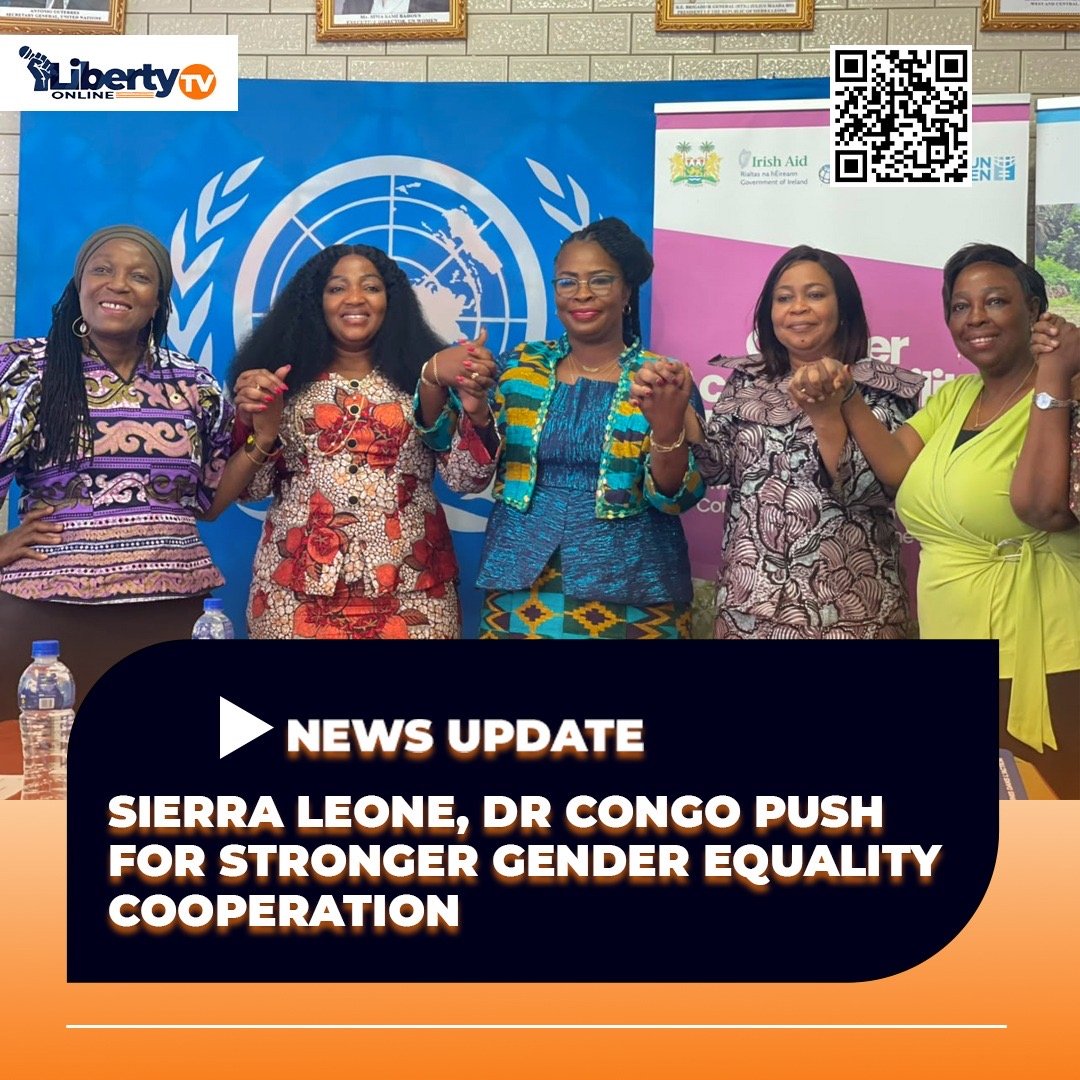
Sierra Leone and the Democratic Republic of Congo (DRC) have held bilateral discussions aimed at strengthening cooperation on gender equality, women’s empowerment, inclusion and the protection of women and children.
The discussions brought together Sierra Leone’s Minister of Gender and Children’s Affairs, Isata Mohoi, and DRC’s Minister of Gender, Family and Children’s Affairs, Micheline Ombaé Kalama, during a press briefing organised by the Ministry of Gender and Children’s Affairs in collaboration with UN Women Sierra Leone on 20 August 2026.
The DRC delegation was in Sierra Leone to support the launch of the Gender Accountability Framework and the first report on the implementation of the Gender Equality and Women’s Empowerment (GEWE) Act. The subsequent engagement provided an opportunity for the two countries to exchange experiences on their respective gender policies, strategies, challenges and practical interventions.
The discussions focused on women’s political participation, economic empowerment, gender-based violence, child protection, positive masculinity and efforts to translate gender policies into tangible outcomes for women and girls.
Sharing the DRC’s experience, Minister Micheline Ombaé said her country has made progress in women’s representation in government and parliament, although significant gaps remain.
She said women currently occupy 36 percent of positions in government, while their representation in parliament has increased from 8.5 percent in 2006 to approximately 12 percent, with 68 women currently serving as parliamentarians.
Ombaé also highlighted the presence of women in key leadership positions, including the Speaker of Parliament, the Prime Minister and the Minister of Foreign Affairs, as some of the notable developments under President Félix Tshisekedi.
However, Ombaé acknowledged that the figures still fall short of expectations.
“It’s not significant, but it is greater than what was there before.”
She said her ministry is revising its National Gender Policy, National Strategy for the Political Participation of Women and National Family Policy to improve coherence between policy commitments and their implementation.
She said the country is also pursuing two economic empowerment strategies, focusing on business and economic development and on women’s empowerment through agriculture.
According to Ombaé, the DRC’s experience has shown that having policies in place is not enough, with implementation and the impact of those policies on women’s everyday lives remaining critical.
The delegation also shared the DRC’s approach to addressing conflict-related violence, particularly against women and girls, who the minister said are among the main victims of the consequences of war and conflict.
She explained that the government has established integrated structures to provide comprehensive support to survivors, with the aim of concentrating services and resources rather than allowing assistance to become fragmented across different institutions.
The DRC is now working to extend those structures beyond Kinshasa to other provinces.
On child protection, Ombaé said the country has validated a new National Child Policy and is working to strengthen coordination among ministries and institutions responsible for children’s welfare.
She said the approach is intended to bring together different actors, including the education sector, to ensure that child protection interventions are better coordinated.
The delegation also highlighted the DRC’s Positive Masculinity initiative, which seeks to involve men in combating gender-based violence and promoting women’s rights.
Ombaé said President Tshisekedi’s designation as an African Union Positive Masculinity Champion has reinforced efforts to change attitudes towards women and encourage men to become active partners in advancing gender equality.
The DRC has introduced positive masculinity programmes in schools and established clubs within ministries and other institutions. It has also begun identifying men who actively support women’s rights as “Ambassadors of Masculinity” to promote the initiative across political parties, civil society and other sectors.
For Sierra Leone, Minister of Gender and Children’s Affairs Isata Mohoi said the engagement offered important lessons that could inform the country’s own efforts to advance gender equality.
Mohoi said Sierra Leone is particularly interested in the DRC’s experience with positive masculinity clubs and how they can help change the attitudes of men, particularly those in positions of influence, towards women and gender-based violence.
She also pointed to the DRC’s experience with women occupying senior political positions, including the Speaker of Parliament.
“Sierra Leone would also love to have a female Speaker in Parliament to help move the gender agenda forward.”
Mohoi said stronger female representation in decision-making could positively influence legislation and policies aimed at improving women’s wellbeing and empowerment.
She also identified financial inclusion and economic empowerment as critical areas for Sierra Leone, arguing that women cannot fully exercise or advocate for their rights without the economic means to do so.
“You cannot empower women to know their rights when they are not financially, economically strong to advocate and also take charge of those rights.”
The minister said Sierra Leone also wants to learn from the DRC’s experience in child participation, particularly its efforts to create platforms through which children can participate in discussions and advocacy on issues affecting them.
Despite the progress shared by both countries, the discussions acknowledged that implementation continues to face challenges, particularly inadequate resources, limited financing and coordination gaps between national and sub-national structures.
Mohoi said financial inclusion remains a major challenge for women in Sierra Leone, particularly for petty traders and small-scale business owners who often lack the capital required to expand their businesses.
She called for stronger collaboration between governments, technical partners and financial institutions to develop financing mechanisms that respond to the specific needs of women.
The engagement also opened discussions on strengthening cooperation beyond the immediate bilateral exchange.
Mohoi said Sierra Leone is interested in building stronger networks among African ministries responsible for gender and children’s affairs, allowing countries to share experiences, undertake reciprocal visits and learn from successful interventions elsewhere on the continent.
She said Sierra Leone plans to host a National Women’s Conference in February, with invitations expected to be extended to gender and children’s ministries from across Africa.
The engagement therefore provided both countries with an opportunity to move beyond policy commitments and examine practical approaches to implementation, while strengthening regional and bilateral cooperation on gender equality, women’s empowerment, child protection and the fight against gender-based violence.


0 comments