
Politics
VP Jalloh Demands Results-Driven Decentralization, Says Era of Slow Implementation Must End
FREETOWN – Vice President Dr. Mohamed Juldeh Jalloh has told Sierra Leone’s decentralization team that the time for talk is over. He wants results. Chairing the Inter-Ministerial Committee (IMC) on…
 Liberty Online TV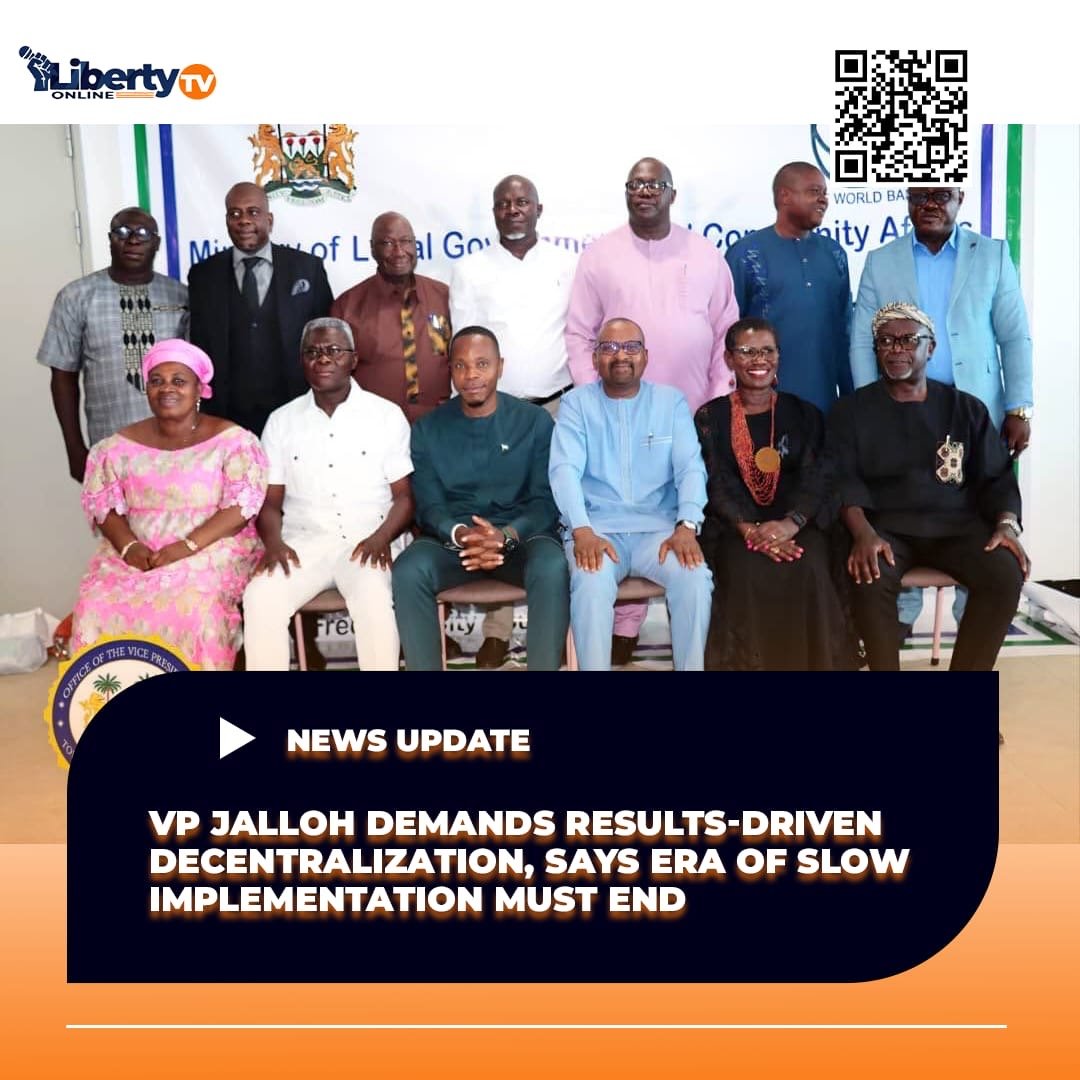
FREETOWN – Vice President Dr. Mohamed Juldeh Jalloh has told Sierra Leone’s decentralization team that the time for talk is over. He wants results.
Chairing the Inter-Ministerial Committee (IMC) on Decentralization this week, Jalloh said the government is shifting from policy discussions to measurable delivery.
“Decentralization must move beyond policy discussions to measurable results,” he said.
The Vice President acknowledged that while commitments have been made and policies developed, those have not consistently translated into real change for citizens.
“We have made commitments. We have developed policies. But we have not consistently translated those into results on the ground. That is the reality,” he said.
Jalloh announced that the IMC Secretariat has now been placed within the Office of the Vice President to ensure stronger coordination. He described the old approach as suffering from weak coordination, implementation gaps, and uneven service delivery.
“This is no longer business as usual,” he warned. “We cannot continue with fragmented institutional approaches, delays in implementation, and systems that do not hold themselves accountable.”
Among the reforms announced are stronger coordination across ministries, changes to the Local Government Service Commission, improved fiscal decentralization, reactivation of Regional Coordinating Committees, and a new IMC Action Tracker to monitor progress.
“Resources must follow functions,” Jalloh said, stressing that devolved responsibilities must come with adequate funding.
He also plans to lead regional consultations in Kenema, Bo, Makeni, and Port Loko, arguing that policy cannot be designed solely from Freetown.
“Too often, we sit in Freetown and design solutions without fully confronting the realities on the ground. So, this will be different,” he stated.
Framing the reform as essential to national stability and equitable development, the Vice President reminded officials who they are ultimately working for.
“Our citizens will not measure us by what we say here today, but by what they experience tomorrow,” Jalloh said. “Let’s get this done.”

0 comments