
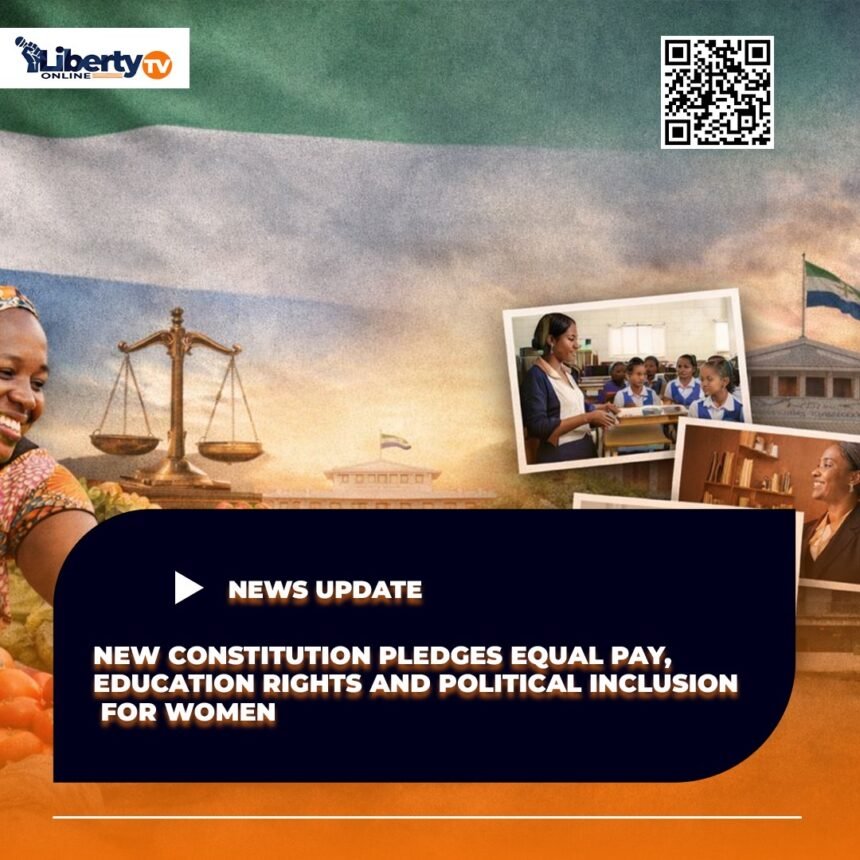
Freetown — Sierra Leone’s proposed New and Improved Constitution is being presented by the government as a major legal shift aimed at strengthening women’s rights while driving national economic transformation.
The message was reinforced on Saturday, January 10, 2026, in Makeni, where the Government of Sierra Leone joined SEND Sierra Leone for the Women’s Collective Monitoring of the Constitutional Review Process.
Addressing women from different parts of the country, Attorney General and Minister of Justice, Alpha Sesay, said the reform is intended to clearly outline what the new Constitution will deliver for women.
“Today, we are in Makeni with SEND Sierra Leone for the Women’s Collective Monitoring of the Constitutional Review Process. It is encouraging to engage women from various parts of the country to discuss what the new Constitution will do for women in Sierra Leone,” Sesay said.
He described the reform as a Blueprint for Prosperity, built on five pillars: Economic Empowerment, Political Power, Social Investment, Justice and Safety, and Human Rights.
“Strong economies are built on strong laws. This Constitution is about ensuring that the law actively supports women’s economic participation,” he added.
Under the leadership of President Julius Maada Bio, the reform moves beyond the peace-building focus of the 1991 Constitution to a development-driven framework that places equality, opportunity, and institutional accountability at the centre of governance.
According to the reform blueprint, women are no longer viewed only as beneficiaries of development, but as key drivers of economic growth. The document introduces constitutional guarantees on the right to work and equal pay for equal work, giving women stronger legal protection against workplace discrimination.
The Constitution also strengthens maternity and family protections. Section 8(3)(c) now mandates special provisions for working women with children, formally recognising the link between caregiving responsibilities and economic participation.
On education, the proposed Constitution replaces the traditional focus on business studies with entrepreneurship, while civic education is elevated to help raise a generation that understands its rights and responsibilities. Government officials say the goal is to raise young people who can create jobs rather than depend solely on them.
Political inclusion is another central feature. Political parties will be constitutionally required to ensure that at least 30 percent of their nominees at national and local levels are women. The adoption of the Proportional Representation electoral system is also expected to widen political space for women, youth, and professionals.
Health and education obligations have also been strengthened. The State is now placed under a clearer constitutional duty to provide adequate medical facilities, while free, quality, and compulsory primary and secondary education is established as a guaranteed right. Officials note that these reforms carry special significance for women and girls, whose health and education directly shape family welfare and national productivity.
The justice system receives renewed attention through provisions on gender inclusivity and non-discrimination, alongside constitutional recognition of Alternative Dispute Resolution to allow faster and more affordable settlement of civil and commercial disputes. The expansion of judicial capacity is expected to reduce delays in land, family, and business cases.
One of the most far-reaching changes concerns citizenship. For the first time, mothers will enjoy equal constitutional rights with fathers to pass citizenship to their children and spouses, ending a long-standing form of legal discrimination.
Government officials say the reforms are intended to strengthen democracy, modernise institutions, and secure equal dignity for all citizens, particularly women.
The proposed Constitution is now being promoted as a practical tool for national progress, directly linking women’s rights to economic development. Citizens have been encouraged to read, understand, and actively participate in the reform process, which authorities describe as a shared national responsibility.
As Sierra Leone prepares for this new legal chapter, the central message remains clear: meaningful economic transformation cannot be achieved without the full inclusion, protection, and empowerment of women.