RECONSTRUCTING THE LIFE OF CHARLES FREDERICK GILPIN: A PRIVATE BOOK LAUNCH IN FREETOWN IGNITES A PUBLIC CONVERSATION ON NATIONAL IDENTITY AND HERITAGE
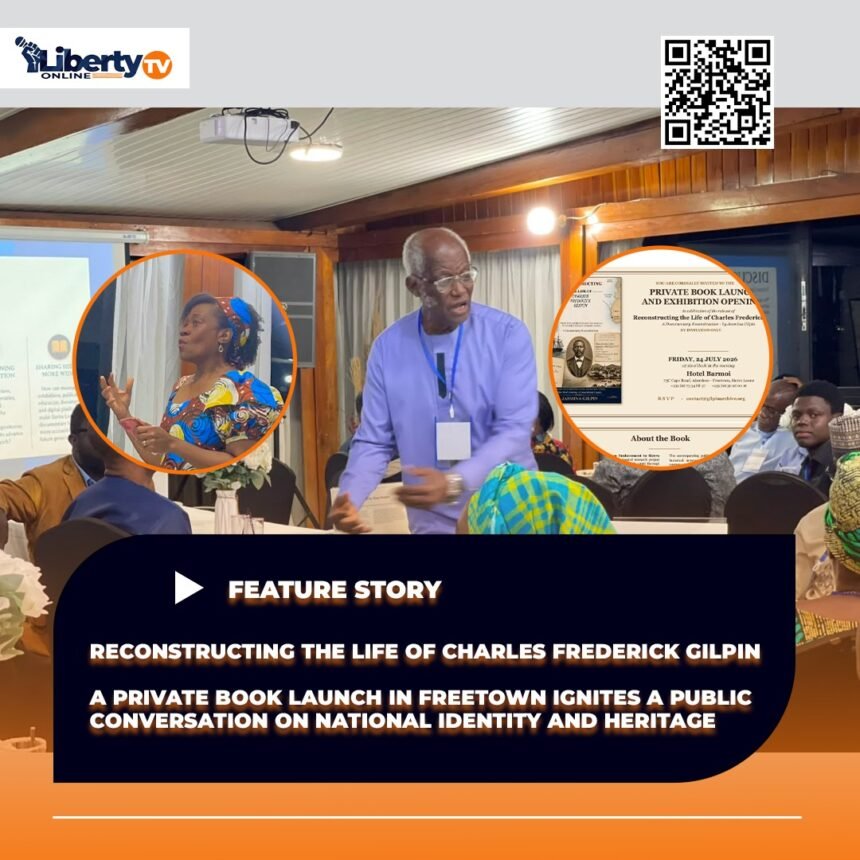
Freetown, Sierra Leone – The evening air at Hotel Barmoi carried more than the usual sea breeze from Aberdeen. Inside, about fifty guests gathered not just for a book launch, but for something that felt like a homecoming. The invitation-only event, hosted by author and researcher Jasmina Gilpin, marked the release of *Reconstructing the Life of Charles Frederick Gilpin*, a documentary reconstruction tracing her great-great-grandfather’s journey from enslavement in South Carolina to freedom and settlement in Bonthe, Sierra Leone.
What began as a private screening and exhibition opening quickly transformed into something deeper: a raw, honest conversation about identity, healing, and the urgent need to preserve Sierra Leone’s documentary heritage.
## A Story Built from Fragments
The evening opened with a short documentary slide presentation, projecting historical artifacts, maps, and archival documents onto the screen. Gilpin walked the audience through her painstaking process of reconstructing a life that history had nearly erased.
“Reconstruction, because they were enslaved, they did not keep many records of them, including births,” she explained. “So I had to use the information available historically to reconstruct his life as he passed from the plantation to Sierra Leone.”
She revealed that her research, spanning archives across the United States, the United Kingdom, and Sierra Leone, built upon groundwork laid by her father, Dr. Humphrey Jartue-Gilpin, who had pieced together fragments of the family story.
The book and accompanying exhibition presented plantation records, military service files from the U.S. Civil War, census returns, missionary archives, and shipping records. It traced Charles Frederick Gilpin’s life from 1838 to 1936, following his path through slavery, emancipation, transatlantic migration, and eventual settlement in Bonthe, Sherbro Island — where he would go on to establish a school and later live out the rest of his life.
She noted the significance of the title. “Reconstructing” acknowledged that enslaved individuals were rarely documented in life, only in ledgers of sale or death. To reconstruct a life like Gilpin’s is to defy that erasure.
## The Data Behind the Story
Among the exhibition panels, a striking chart caught attention. It displayed the regions of origin for Liberated Africans who settled in Sierra Leone between 1808 and the 1870s. The Bight of Benin contributed 38.5%, the Bight of Biafra 31.5%, and the Sierra Leone region itself only 12.9%. The data told a story of displacement on a massive scale — nearly 100,000 people uprooted and brought to one small stretch of West African coast.
Gilpin addressed a common misconception directly. Many assume the Krio people originated primarily from Nova Scotia or London, but the numbers tell a different story. Those from Nova Scotia and Britain made up only a small fraction of those who settled. The vast majority, over 80%, came from the Bight of Benin and Bight of Biafra, taken from slave ships and liberated by the British Navy. The Sierra Leone region itself contributed just under 13%.
“We need to heal from slavery and not make it feel like one group is better than the other,” she said. “We are all connected by this history.”
Gilpin also pushed back on how the scale of the transatlantic slave trade is commonly understood. The widely cited figure of roughly 10 to 12 million people is typically a count of those initially captured and transported. But because chattel slavery was hereditary — passed from parent to child for generation after generation until abolition — that number tells only part of the story. Drawing on population data up to abolition in the United States in the 1860s, along with comparable estimates for the Caribbean and South America, Gilpin calculated that an estimated 56 million people lived through some period of chattel slavery stemming from the transatlantic trade, once descendants born into bondage are counted alongside those originally taken. It is her own calculation rather than an official historical consensus figure, but she argued it reframes the true human scale of the institution — not as a single act of capture, but as a system that swallowed generation after generation.
Another exhibition panel titled “Change of Name” listed African names like Abubakr, Agbebi, Iyabo, and Yalla, alongside the ages of individuals when they were recorded. The data revealed that 57% of the 42 individuals examined were between 7 and 13 years old when liberated. Children, many of them, arriving alone in a new land, given new names, learning new languages, building new lives from the wreckage of the old.
The evidence table in the exhibition showcased the project’s commitment to transparency: marriage and death certificates, military records, census data, oral histories, family Bible entries, DNA evidence, and newspaper notices. Each piece of evidence was rated for confidence — high, medium, or low — demonstrating that this was not a romanticized family legend but a rigorously documented historical reconstruction.
## “We Have Been Dehumanized to a Point Where We Cannot Truly Love Ourselves”
As the formal presentation ended, the room shifted into discussion. What followed was not a polite Q&A but a genuine, sometimes emotional, exchange about Sierra Leone’s divisions and the work still needed.
Ambassador Raymond D’Souza George, a renowned historian, offered a broad historical lens that set the tone for the conversation. He spoke about the lingering psychological wounds of slavery and colonization.
“Whenever we have these discussions, we should think about how colonization and enslavement has dehumanized us to a point that we cannot truly love ourselves,” he said. “Even if we need to fake it, we need to love one another truly.”
He challenged the room to consider independence critically, pointing out that freedom from colonial rule had not always meant freedom from dependence.
“This freedom we fought to get from our colonial masters — what we actually do is put ourselves in a position of greater dependence on the western world,” he observed.
He acknowledged that tribalistic tendencies exist everywhere, not as inherently harmful but as a natural human inclination toward familiarity. The danger, he warned, comes when those tendencies are instrumentalized for division.
Bowenson F. Phillips, former Freetown Chief Administrator, built on this foundation with a call to action around cultural preservation.
“Krio is probably the most diverse melting pot of culture and language anywhere in the world, maybe even in all of human history, when you consider how Freetown came to be. The problem is, it was never systematically documented. We never made the case that Freetown should be recognized as a cultural heritage site, with a language and people that represent most parts of the world.”
He noted the work of the late Professor Jones on the Krio dictionary decades ago, but pointed out that language dynamics have since changed. He called for an updated framework, a new epistemology, for understanding and documenting Krio culture.
“We need to decolonize our heritage. We took what the western perspective told us and accepted it,” Phillips said.
He urged the audience to connect with all places of Krio lineage and descendants, like the Saro in Nigeria, because the story was bigger than any one group.
“This is not only about Krio culture but also about our African heritage,” he said. “The Krio offer a unique perspective on the dynamics of how different cultures interact and transform over time.”
He closed with a simple but powerful message: “While we all need to be proud of our cultural heritage, we need to have mutual respect for one another.”
Kadijatu Bintu Kanu, Acting Principal of Methodist Girls’ High School, spoke next with urgency about the present moment.
“We need to accept ourselves. We need to move away from marginalization. Saying ‘this is Krio and this is country’ will not help us as a nation. We need to end stereotypes. We are all one, regardless of our ethnicity.”
Isatu Smith, a heritage professional, shared a personal story that illustrated the lived reality of these divisions. Born to a Soso mother and a Krio father, she felt, growing up, the weight of not fully belonging to either side.
“I experienced stigmatization growing up. My mother is Soso by tribe and my father is Krio, and it was a struggle for my father’s side to fully accept me because of my provincial affiliation. I had to force myself to be accepted. I lean more toward my mother’s side.”
She added a sharp observation about how these divisions have been weaponized: “This ethnicity divide among Sierra Leoneans — the politicians are weaponizing it. The country-Freetown divide.”
Young Voices, Fresh Perspectives
One of the most striking contributions came from a seventeen-year-old girl in the audience. She said the slave trade had been presented to her like a movie, not like history. She believed more needed to be done to teach this story in schools — not as spectacle, but as lived reality.
A young man suggested that schools should move beyond purely theoretical teaching of history and take students on excursions to historic sites to learn practically.
Another attendee proposed periodic cleaning and maintenance of historic sites to make them more appealing to both Sierra Leoneans and foreign visitors.
## A Legacy in the Making
The exhibition panels framed the evening’s themes with thoughtful questions: How might records hold the stories of the past, present, and future? How can we document communities across time? What perspectives can we bring to the study of Sierra Leone’s documentary heritage?
Jasmina Gilpin’s project is more than a book. It is a model. She demonstrated that through archival research, genealogical methods, and collaboration across continents, a single life can be reconstructed — and in doing so, an entire history can be reclaimed.
As the evening wound down, guests lingered by the exhibition panels, examining the marriage certificate from 1877, the death certificate from Bonthe, Sherbro Island, dated 1936, the military record from the U.S. Civil War, and the family Bible entries. Each document represented a small victory against forgetting.
And in the conversations that continued into the night, it was clear the event had sparked something larger. It wasn’t just about Charles Frederick Gilpin anymore. It was about Sierra Leone itself — its divisions, its beauty, its complexity, and the urgent need to tell its stories before they slip away.