
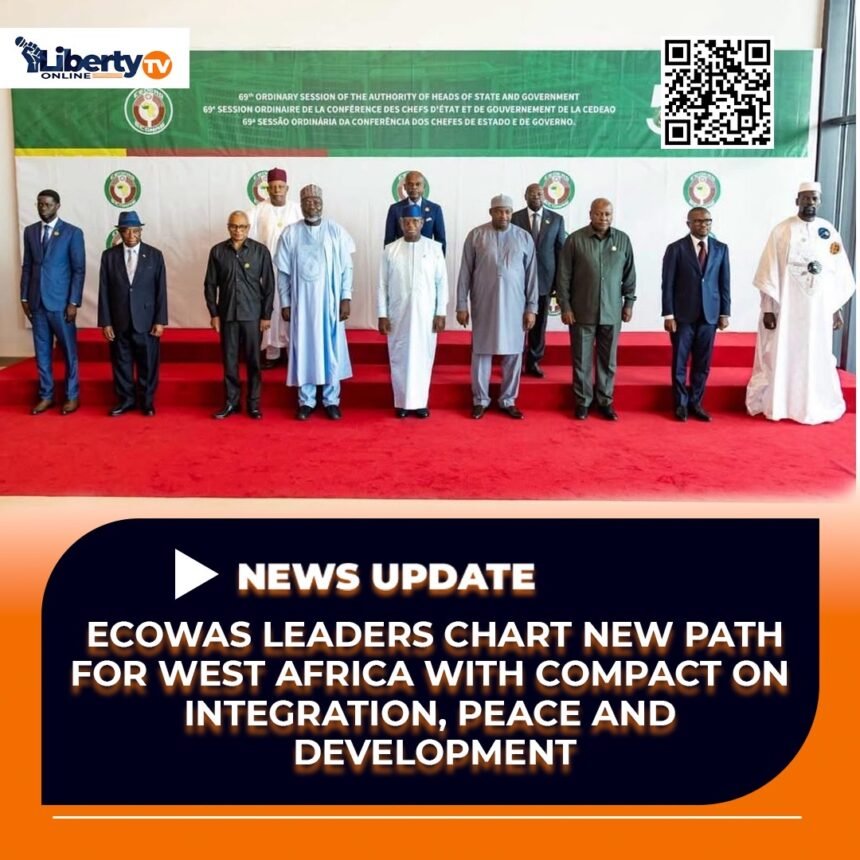
Lungi, Sierra Leone:
West African leaders have adopted a new regional integration framework designed to strengthen peace, security and economic cooperation as ECOWAS seeks to address emerging challenges and deepen unity among member states.
Known as the Compact for the Future of Regional Integration in West Africa, the framework was adopted during the Summit on the Future of Regional Integration and the 69th Ordinary Session of the ECOWAS Authority of Heads of State and Government in Lungi, Sierra Leone.
In his address at the summit, Sierra Leone’s President Julius Maada Bio, who was then Chairman of the ECOWAS Authority of Heads of State and Government, said the Compact represents an opportunity for the region to move beyond commitments and focus on implementation.
“The next 50 years of ECOWAS will not be defined by the declarations we adopt, but by the results that we deliver,” President Bio said.
He said the future of West Africa depends on the ability of member states to anticipate challenges, strengthen institutions and preserve peace and security.
“Foresight is an expression of sovereignty. Those who anticipate change retain the freedom to shape their future,” President Bio added.
The Compact identifies peace and security as a foundation for regional integration, with a focus on addressing terrorism, violent extremism, organised crime, unconstitutional changes of government and other threats to stability.
President Bio said lasting security requires more than military responses, stressing that governance, economic opportunity and public trust in institutions are essential to maintaining peace.
“Lasting security cannot be secured by force alone. It also depends on effective governance, economic opportunity, justice and citizens’ confidence that public institutions serve and protect them,” he said.
The Compact is anchored on key priority areas including peace and security; sustainable economic transformation and regional prosperity; science, technology, innovation and digital transformation; youth, women and future generations; institutional reforms; partnerships; implementation mechanisms; strategic autonomy and democracy.
Ghana’s President John Dramani Mahama welcomed the framework, describing it as a roadmap capable of unlocking the potential of the region if fully implemented.
“There is no doubt that the eventual adoption and implementation of these six pillars of the Compact will unleash the potential benefits to our community’s citizens,” President Mahama said.
He stressed that peace remains central to development and called for continued dialogue and cooperation among ECOWAS member states.
“Geography has made us neighbours. History has made us partners, and our future requires us to remain one West African family,” Mahama said.
Speaking on behalf of Nigeria’s President Bola Ahmed Tinubu, Vice President Kashim Shettima reaffirmed Nigeria’s commitment to the Compact, describing it as a significant milestone in the region’s integration journey.
Shettima said the framework provides a practical pathway for building a more resilient and people-centred ECOWAS while addressing political, security and economic challenges.
He also emphasised the need for stronger cooperation against terrorism and insecurity, saying regional stability remains critical to achieving economic transformation.
“A sustainable economy cannot be achieved without an environment of peace, security and stability,” Shettima said.
The summit also featured the signing of the Declaration of Commitment to the Compact of the Future of Regional Integration in West Africa, the Inter-Governmental Agreement for the African Atlantic Gas Pipeline Project, and the Presidential Declaration on Advancing Gender Parity in Political Representation in ECOWAS Member States as part of the bloc’s 50th Anniversary Legacy Initiatives.
ECOWAS leaders also reviewed reports on the state of the community, regional security and the work of the Council of Ministers, as the bloc seeks to strengthen its institutions and deepen cooperation among member states.
The adoption of the Compact marks a renewed commitment by ECOWAS leaders to build a more integrated, peaceful and resilient West Africa capable of responding collectively to regional and global challenges.