
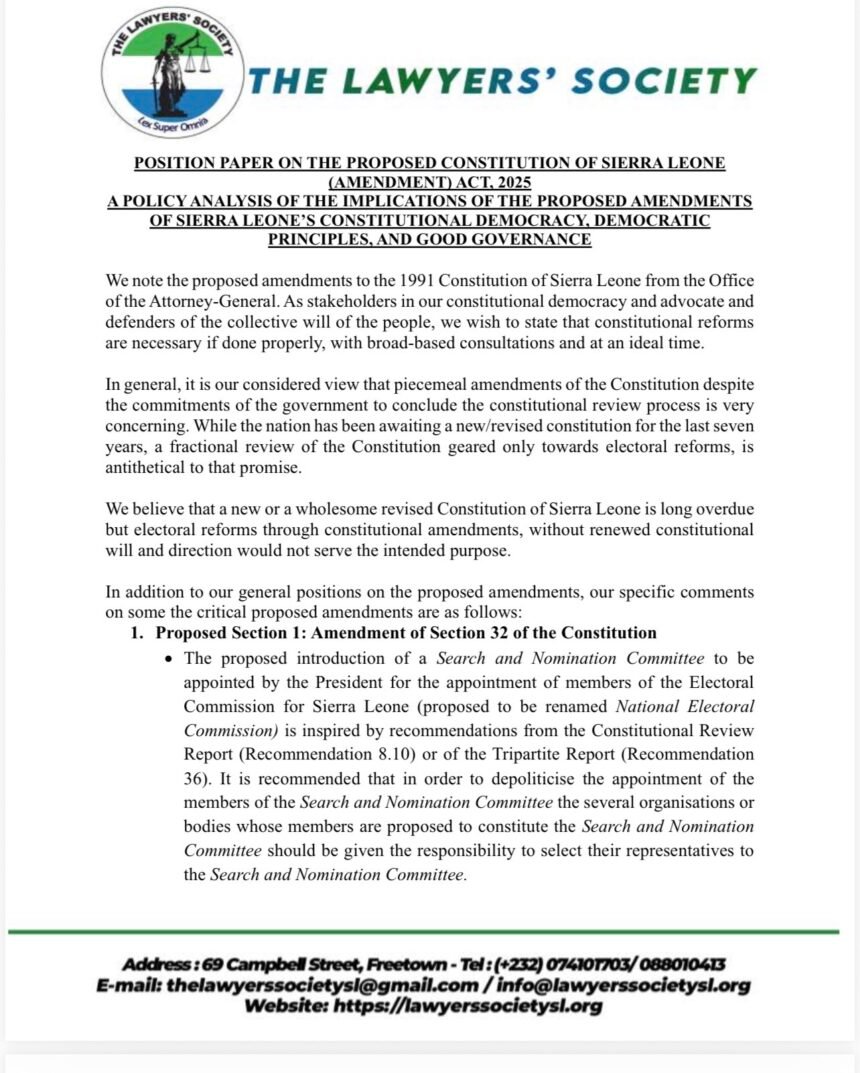
A coalition of constitutional stakeholders, led by the Lawyers’ Society, has raised serious concerns over the proposed Constitution of Sierra Leone (Amendment) Act, 2025, warning that selective electoral reforms could weaken democratic governance and derail the country’s long-promised comprehensive constitutional review.
In a position paper responding to proposals from the Office of the Attorney-General and Ministry of Justice, the Lawyers’ Society acknowledged that constitutional reform is necessary but stressed that it must be undertaken through broad, inclusive consultations and at an appropriate time. The group argued that fragmentary amendments—largely focused on electoral matters—contradict government commitments to deliver a new or fully revised constitution, a process that has remained stalled for more than seven years.
Electoral Governance and Appointments
According to the position paper, proposals to amend Section 32, which would introduce a Search and Nomination Committee appointed by the President for the Electoral Commission, draw from recommendations of the Constitutional Review Committee (CRC) and the Tripartite Committee. However, the Lawyers’ Society insisted that if the process is to be genuinely depoliticised, stakeholder institutions must be allowed to nominate their own representatives, rather than having them selected by the President.
The paper further noted that the powers of the proposed committee remain unclear, particularly whether its recommendations would be binding. It also called for the exclusion of former ministers, Members of Parliament, and active political party officials from serving as electoral commissioners.
Similar concerns were raised regarding proposed amendments affecting the Political Parties Registration and Regulation Commission (PPRRC), with the group warning against excessive political influence over regulatory bodies.
Gender Quota and Representation
On Section 35, the Lawyers’ Society welcomed the move to constitutionalise a 30 percent quota for women, describing it as consistent with the Gender Equality and Women’s Empowerment Act, 2022. However, it cautioned that under the district block proportional representation system, political parties could still undermine women’s participation by placing female candidates in unwinnable positions unless clear placement rules are enforced.
Census Data and Gerrymandering
The proposed amendment to Section 38, which would allow parliamentary seat allocation based on the most recent census while prohibiting the use of census data within 24 months of an election, was endorsed by the group as an important safeguard against gerrymandering.
Independent Presidential Candidates
Addressing Section 41, the Lawyers’ Society supported proposals to allow independent presidential candidates to contest elections. However, it strongly rejected requirements for candidates to demonstrate “sufficient financial capacity,” describing such conditions as elitist, exclusionary, and inconsistent with democratic principles. Instead, the paper recommended reliance on reasonable nomination thresholds.
Presidential Threshold and Election Petitions
On proposed changes to Section 42, the position paper criticised the introduction of a dual threshold—a simple majority combined with 20 percent support in two-thirds of districts. The Lawyers’ Society argued that the proposal lacks backing from CRC and Tripartite Committee recommendations and could lead to more run-off elections, increased risks of manipulation, and heightened electoral violence.
Regarding election petitions, the group said the proposed timelines for filing are unrealistically short. It recommended a total of seven days for filing petitions, while supporting the proposed 14-day deadline for Supreme Court determinations. The paper also urged reducing the 60-day period for conducting fresh elections after an invalidated run-off to 30 days.
Fixed Election Dates
The proposal to introduce fixed presidential election dates was described as progressive but potentially impractical. The Lawyers’ Society pointed to November’s heavy rains and possible impacts on tourism and logistics. It recommended that inauguration dates should also be fixed and that the powers of outgoing presidents during transition periods be clearly limited.
Dual Citizenship and Public Service
On Section 76, the group opposed selective amendments that would allow dual citizens to serve as ministers without extending similar provisions to Members of Parliament. The Lawyers’ Society argued that such changes should apply uniformly and be subjected to a national referendum. However, it supported reducing the resignation period for public servants contesting parliamentary elections from 12 months to six months.
Political Parties and Consequential Amendments
The position paper criticised attempts to amend ordinary legislation through constitutional provisions, recommending that such changes follow separate legislative processes. It also strongly rejected proposals to deregister political parties that fail to win elections, warning that this would weaken multiparty democracy, particularly in light of the high proportional representation threshold.
Conclusion
The Lawyers’ Society reaffirmed its support for constitutional reform but cautioned that isolated and piecemeal amendments risk weakening political commitment to a comprehensive constitutional overhaul. The group called on authorities to pursue a balanced approach—one that addresses urgent reforms while keeping faith with the long-overdue promise of delivering a new, people-centred constitution for Sierra Leone.