
As digital commerce surges across West Africa, Sierra Leone is wrestling with a critical question: are its laws equipped to protect businesses and consumers in an increasingly online economy?
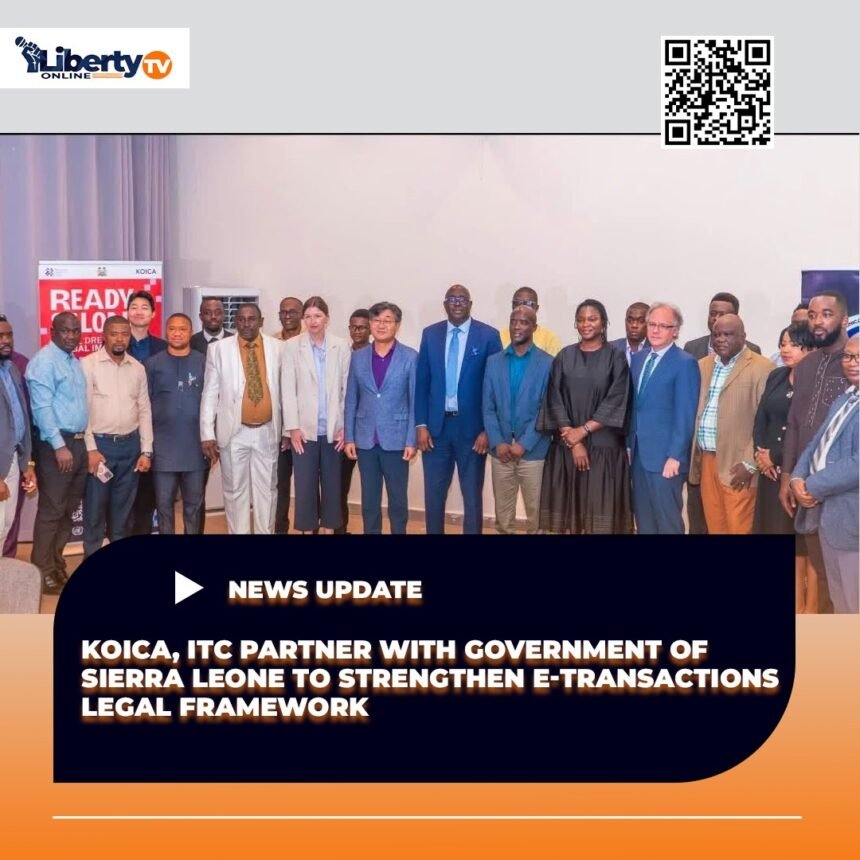
The Ministry of Communication, Technology and Innovation and the Ministry of Trade and Industry, with support from KOICA and the International Trade Centre, recently convened a public-private dialogue to examine gaps in the country’s e-transactions legal framework. The engagement forms part of the READY Salone initiative, a digital empowerment program targeting young Sierra Leoneans aged 15 to 35.
KOICA Country Director Kim Eunsub opened the proceedings, highlighting the development agency’s focus on digital enablers as a pathway to sustainable and inclusive economic growth.
For businesses, the stakes are clear. An electronic signature or digitally formed contract must be legally enforceable. Without that certainty, companies risk delivering goods or services only to have counterparties disavow agreements on technical grounds, a scenario that erodes trust and chokes investment in e-commerce.
Discussions are centering on aligning Sierra Leone’s domestic legislation with internationally recognized standards. The UN Commission on International Trade Law’s model frameworks, adopted by scores of countries, offer a proven blueprint. But regional dynamics are increasingly influential: ECOWAS has developed binding protocols, and the African Continental Free Trade Area’s digital trade protocol, once fully operational, will introduce continent-wide obligations covering platform liability, artificial intelligence governance, and more.
Legal experts guiding the process emphasize two core concepts. The first is “functional equivalence”—ensuring digital transactions receive the same legal treatment as paper-based ones. The second is “technological neutrality,” which prevents the law from locking in specific technologies that could quickly become obsolete. Under this approach, rules would validate any identity verification method—whether passwords, biometrics, or facial recognition—provided it meets established reliability standards.
Participants also grappled with more intricate issues. Automated contracting, where software agents execute transactions without human intervention, is already common in supply chain management. Questions of liability, error correction, and contract formation in such scenarios remain legally unsettled. Cross-border transactions add another layer of complexity. When a consumer in Sierra Leone purchases from a seller in Nigeria, determining which country’s laws govern the contract, and where legal recourse lies, is far from simple. Electronic transferable records, which would allow documents like bills of lading to move digitally, present further regulatory challenges.
Officials stressed that transaction law and payments regulation, while distinct, are deeply interdependent. A valid contract matters little if the settlement mechanism is unreliable or vulnerable to fraud. The dialogue acknowledged that both legal tracks require coordinated attention to build a functional digital commerce ecosystem.
With AFCFTA implementation gathering momentum and WTO e-commerce negotiations progressing, Sierra Leone faces both pressure and opportunity. Early adoption of robust, internationally compatible rules could position the country as a competitive digital hub. Delays, conversely, risk leaving domestic businesses exposed to legal uncertainty in an increasingly borderless marketplace. Further stakeholder consultations are anticipated before legislative proposals move forward, with participants describing the recent dialogue as a foundational step rather than a conclusion.