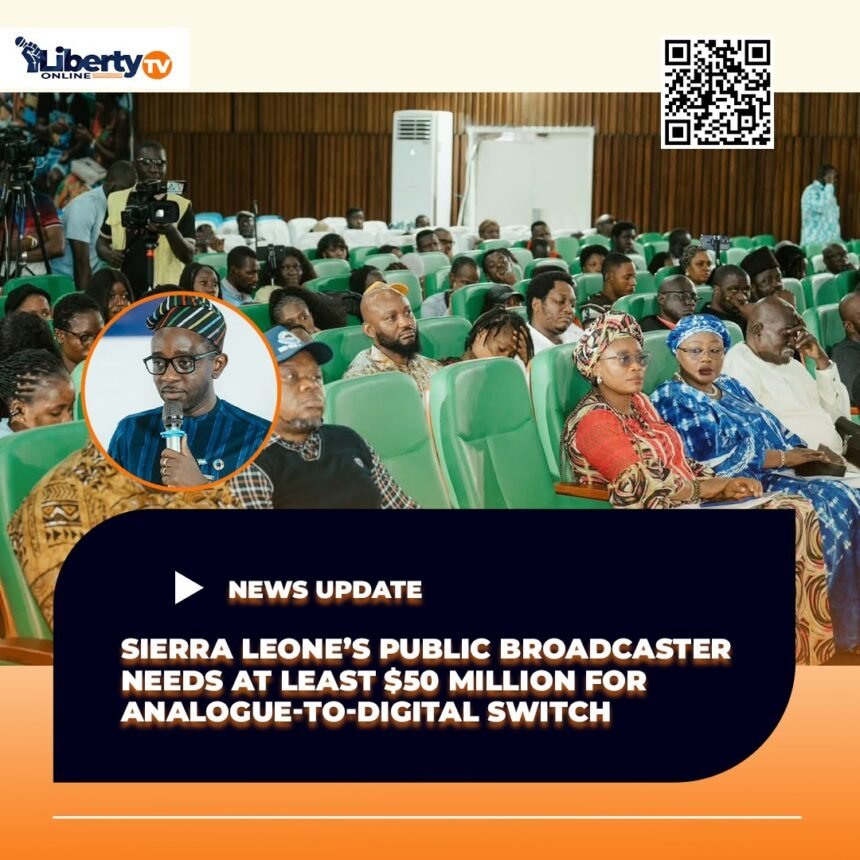
The Sierra Leone Broadcasting Corporation needs at least US$50 million to migrate from analogue to digital broadcasting, Minister of Information and Civic Education Chernor Bah has said.
Bah described the figure as the most conservative estimate he has seen of what the transition may cost, indicating the final bill could be higher. He made the disclosure at a national conference on sustainable funding for the public broadcaster, held at the Miatta Conference Centre in Freetown on 8 October 2026 under the theme “Ring-Fencing Funding for the Sierra Leone Broadcasting Corporation.”
“SLBC belongs to the people of Sierra Leone,” Bah told delegates. He said the Corporation’s credibility depends on fairness, professionalism, editorial independence, sound management and public accountability, and that it must provide citizens with reliable news and a fair hearing for all.
Deputy Minister of Information and Civic Education Bockarie Abdel Aziz Bawoh set the stage for the conference, saying it provided a platform to examine the role of public broadcasting in Sierra Leone’s democratic development and to identify practical measures to strengthen SLBC as a national institution.
Presenting the state of the Corporation, SLBC Director-General Josephine Kamara told delegates it was running at a loss. In the 2025 financial year, SLBC recorded total revenue of NLe9.57 million against expenditure of NLe16.96 million — a deficit of NLe7.39 million. Between January and June 2026, revenue stood at NLe1.77 million against expenditure of NLe2.49 million, leaving a deficit of about NLe718,251.
Kamara said operating costs can rise to nearly NLe20 million, driven largely by generator expenses at the Leicester Peak and New England Ville transmission sites, and that SLBC projects its 2027 expenditure at more than US$12.05 million.
She said the Corporation’s public-service obligations, including rural broadcasting, regional programming, elections, emergency communication and civic education, generate limited commercial returns, making advertising and sponsorship insufficient as a sole funding source. She also cited ageing transmission and studio equipment, inadequate digital infrastructure, maintenance pressures and uneven capacity across regional stations, noting SLBC lacks a substantive server for independent digital broadcasting.
Delivering the keynote on behalf of Vice President Mohamed Juldeh Jalloh, Bah presented what he called two systemic challenges that make investment in SLBC especially clear — the first being the transition from analogue to digital.
He said Sierra Leone is one of the few countries in the region yet to make the transition, despite years of international commitments and despite having one of the oldest public broadcasters in the region.
“The transition can change what our broadcast system can deliver,” Bah said. He explained that digital transmission allows several television or radio channels to share capacity where analogue uses a single channel, improves picture and sound quality, allows more programming and creates opportunities for new content producers. Shared transmission infrastructure, he added, can also reduce the need for each broadcaster to build an entire network of its own.
He said the transition requires new transmission systems, technical skills, clear governance and a practical implementation plan.
“The most conservative estimate that I have seen of what that is going to cost is at least 50 million United States dollars,” Bah said.
He said the transition was a commitment Sierra Leone had made, and a global one, and that it required attention to the viewer. Households will need to move from old receivers to digital set-top boxes, he said, and government must explain those changes to the public so that no one is left behind.
Bah said the financial position of the transition must be carefully examined, because it also carries significant opportunities. He said the transition opens up valuable spectrum — the digital dividend — which can be licensed to generate revenue, a sum he described as significant enough to contribute meaningfully to financing the transition itself.
He said the transition must be tied to a fully funded national plan. Consultants had been engaged and the study had been done, he said, but a fully funded plan was not yet in place.
Bah said government was also considering predictable budgetary support, legislative measures and a possible dedicated public broadcasting fund. Any mechanism, he said, must be transparent, affordable and capable of protecting SLBC’s public-service mandate, with clear accountability so citizens could see how much the broadcaster receives, how funds are spent and what services are delivered.
The second challenge, Bah said, was the unfinished new SLBC building. Its construction began in the 1970s but was abandoned in the early 1980s. The structure contains more than 50 rooms and a large auditorium and could potentially house modern studios, production facilities, training spaces and archives. Bah said government must first determine the building’s structural viability, rehabilitation cost and financing model.
On financing reform, Amir Lawyer Mewa warned against making SLBC’s funding dependent on ministerial discretion, saying such an arrangement could expose public broadcasting to political pressure.
“We don’t want the policy to be determined by the Minister,” Mewa said, stressing that funding should not be withheld even if SLBC’s editorial policy conflicts with government.
Media stakeholder Julius Spencer said the objective was to establish a sustainable financing architecture, adding that the challenge was not simply to find money for SLBC. Public resources, he said, should be tied to clearly defined public-service obligations, and any financing model should strengthen sustainability and programme quality.
Edward Kargbo of BBC Media said predictability was significant in determining the source of funding, and that the case for the public broadcaster had to be made in a way that could win public support.
Bawoh said the government’s objective was to reposition SLBC as a genuine public broadcaster serving citizens, rather than one driven primarily by political, commercial or corporate interests.
“We need a democratic public broadcaster that provides citizens with information that serves the public interest,” he said. He added that while advertising and commercial revenue could support SLBC, they could not reliably finance universal coverage, infrastructure development and other public-service obligations.
Bah urged stakeholders to move beyond identifying problems and produce credible financing options, legislative recommendations and clear implementation timelines. He called for continued engagement with Parliament, the private sector, communities and development partners.
“The future of our national broadcaster cannot rest solely on the shoulders of one minister or government institution. It must become a national commitment,” Bah said.