By Alisious Ligurie Matthew Kongo
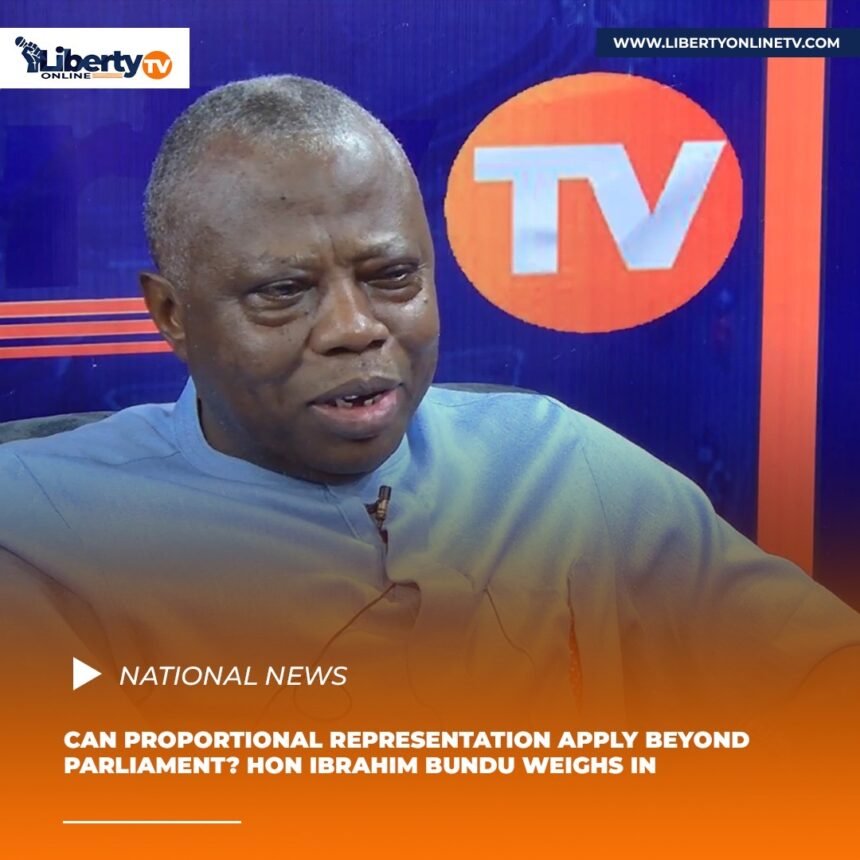
During Liberty Online TV’s Breakfast Show, we had the privilege of hosting seasoned former parliamentarian Mr. Ibrahim Bundu, who brought his wealth of legislative experience to an engaging discussion on the applicability of the Proportional Representation (PR) system in Sierra Leone.
Our central question: Can PR extend beyond Parliament to the Executive and local councils?
Understanding PR and Its Constitutional Roots
Mr. Bundu began by clearing up common misconceptions around PR. He explained that Proportional Representation is a system designed to ensure fair distribution of political power and inclusivity, fulfilling the constitutional demand that governance should serve all Sierra Leoneans.
He reminded viewers that PR was first introduced in 1996 under Section 38 of the 1991 Constitution, mainly as an emergency measure when the entire country functioned as one constituency during the civil war. He also noted his personal experience with PR in 2002, while highlighting differences between that period and its more recent application in 2023.
“PR is not new,” Bundu emphasized. “Even the President’s oath of office speaks to sharing the country’s resources proportionally. That is the spirit of the constitution.”
PR and Parliament vs. Executive and Councils*
Historically, PR has been used only for parliamentary elections. The Executive branch—President, Vice President, and Cabinet—remains elected or appointed under separate rules, while local councils traditionally use a first-past-the-post system at ward level.
Still, Bundu believes the principles of PR—fairness, inclusivity, and power-sharing—should influence how the Executive governs and how councils function, even if the law does not formally apply PR to them yet.
*A Case for Inclusion and National Cohesion*
Mr. Bundu argued that Sierra Leone’s “winner-takes-all” political culture has fueled division and undermined cohesion. He praised PR for offering a path to broader representation, especially for opposition voices.
“Power is for every Sierra Leonean,” he said. “If the government truly wants cohesion and fairness, applying PR is not unlawful—it is a realization of what the constitution already commends.”
He also stressed the importance of awareness raising, so citizens understand the advantages of PR and political parties take responsibility to field representatives. “If a party fails to present candidates, they should not blame the system. I blame the parties, not PR.”
On Elections, Disputes, and Accountability
*
Addressing electoral disputes, Bundu reminded citizens that disagreements should be settled in court, not through political unrest. He pointed to the formation of the Tripartite Steering Committee between APC and SLPP as a positive example of reconciliation.
“The constitution is our biggest safeguard,” he said. “The moment we fail to follow it, problems begin. Let’s read the laws, hold leaders accountable, and put country above party.”
Mr. Bundu concluded by underscoring that PR, in both spirit and practice, reflects the direction Sierra Leone’s constitution points towards: fair representation, inclusion, and shared governance.
“I don’t want to listen to criticisms of PR,” he said firmly. “Being Sierra Leonean is bigger than being in government. Over-partisanship has never worked, and it never will.”