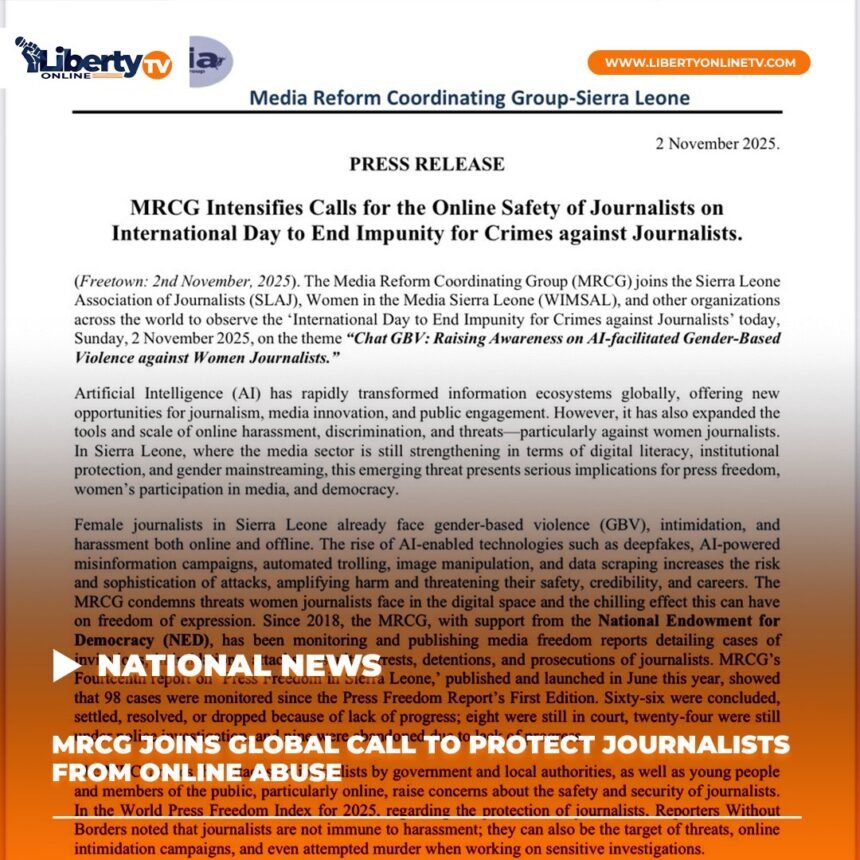
The Media Reform Coordinating Group (MRCG) has called for a stronger online safety measures and accountability for crimes against journalists as the world marks the International Day to End Impunity for Crimes against Journalists today, under the theme “Chat GBV: Raising Awareness on AI-Facilitated Gender-Based Violence against Women Journalists.”
In a press statement dated November 2, 2025, the MRCG joined the Sierra Leone Association of Journalists (SLAJ), Women in the Media Sierra Leone (WIMSAL), and global partners in highlighting the growing dangers of online abuse, particularly those amplified by Artificial Intelligence (AI).
While recognizing the positive impact of Artificial Intelligence’s (AI) tools on journalism and communication, the MRCG also warned about its misuse, highlighting fake news, misinformation, automated trolling, and image manipulation as well as emphasizing how it has increased the scale and sophistication of attacks against women journalists.
“Female journalists already face significant threats, both online and offline,” the statement noted. “AI-enabled tools now make these attacks more invasive and damaging, with serious implications for press freedom, gender equality, and democracy.”
The organization further explained that since 2018, with support from the National Endowment for Democracy (NED), the MRCG has tracked and published reports on media freedom violations in Sierra Leone.
Citing its 14th Press Freedom Report published in June 2025, MRCG highlighted a record of 98 cases of threats and attacks on journalists, with 66 cases resolved and dropped, eight in court, 24 cases still under and nine of them have been stalled.
The organization also cited recent incidents this year, including the barring of journalist Melvin Tejan Mansaray from Parliament, the online harassment of Umu Thoronka and Yusuff Moseray Suma, and the physical assaults of Prince Christopher Kamara, Alusine Rehme Wilson, and Foday Fofanah.
MRCG further referenced the 2025 World Press Freedom Index by Reporters Without Borders, which found that journalists globally continue to face harassment, intimidation, and threats when reporting on sensitive issues.
Through support from the Media Foundation for West Africa (MFWA) and the Embassy of the Kingdom of the Netherlands in Ghana, the MRCG is implementing initiatives focused on digital safety, women’s digital rights, and accountability governance. Training sessions for female journalists have addressed issues such as AI-generated disinformation, deepfake imagery, doxxing, and gendered hate speech.
Marking the day, the MRCG called on the Government of Sierra Leone to uphold its obligations under the United Nations resolution establishing November 2 as the International Day to End Impunity for Crimes against Journalists. The resolution, adopted in 2013, urges member states to ensure justice for journalists who face violence and to end the culture of impunity surrounding such crimes.
“Protecting journalists, especially women, is not just about safety,” MRCG emphasized. “It’s about protecting democracy itself.”