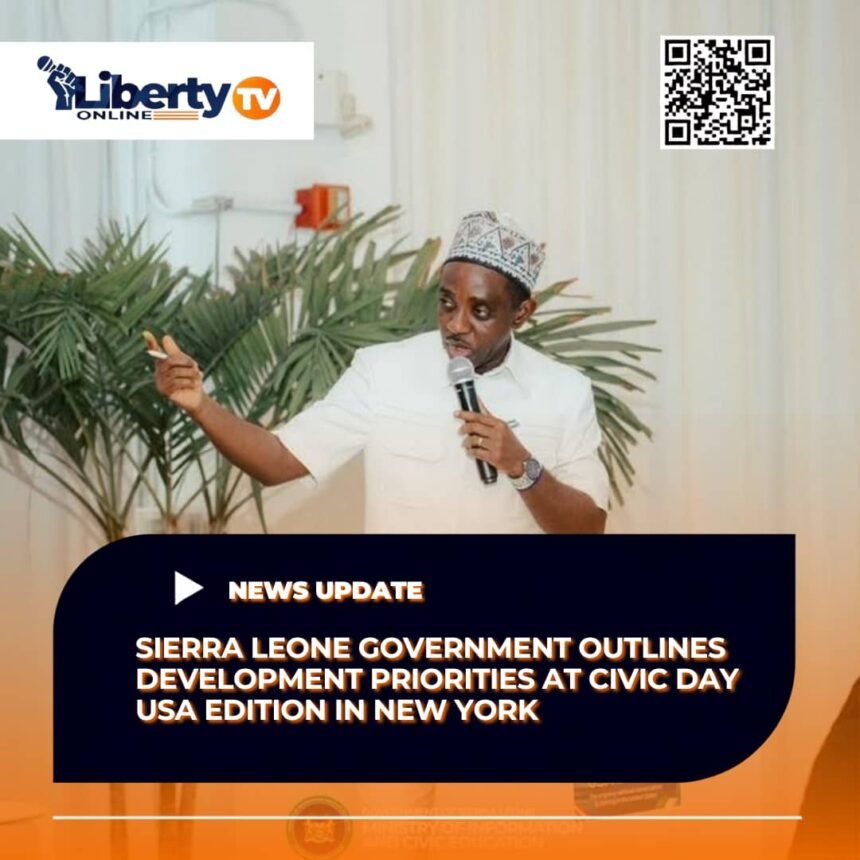
Sierra Leone Government Outlines Development Priorities at Civic Day USA Edition in New York
The Government of Sierra Leone has used its Civic Day USA Edition in New York to outline ongoing programs and proposed reforms across key sectors, including electricity, fisheries, youth employment, education, healthcare, artificial intelligence, constitutional reform and public-sector transformation.
The event, held on Thursday, 24 September 2026, as part of the Ministry of Information and Civic Education’s Civic Day Series, brought together senior government officials and Sierra Leoneans in the diaspora during the 81st United Nations General Assembly. The New York engagement was designed to provide updates on government policies and programs while allowing Sierra Leoneans abroad to raise issues concerning national development.
At the session, ministers provided sector-specific updates on government interventions and plans, while also responding to concerns relating to public services, economic opportunities and governance.
Disability inclusion and social protection
Minister of Social Welfare Melrose Karminty said the Government is working to strengthen support for vulnerable groups, particularly persons with disabilities, women, children and young people.
She said legislation and policy would have limited impact without corresponding services, particularly in education and healthcare. The Ministry, she explained, is working with UNICEF and the London School of Hygiene and Tropical Medicine to improve the identification, assessment and certification of persons with disabilities.
The initiative is also expected to strengthen disability data collection and early identification through communities, health facilities and schools.
Karminty said better data would help connect persons with disabilities to appropriate interventions, including glasses, hearing aids and specialised services. She also highlighted rehabilitation, vocational training and skills development, including support for district-based centres with computers and other equipment to expand opportunities in areas such as computer science.
$55 million industrial fishing harbour
Minister of Fisheries and Marine Resources Princess Dugba announced that construction has commenced on the $55 million Julius Maada Bio Industrial Fishing Harbour at Black Johnson, with financing provided through a grant from China.
She clarified that the grant would not be transferred to the Government as cash. Instead, the Chinese side would finance implementation through a contractor engaged for the project.
The planned facility will include a jetty, waste-management system, marine house and fish market, with the Government expecting it to support industrial fishing and improve fisheries management.
Dugba said a temporary jetty is expected to be completed within two months to accommodate large fishing vessels while construction of the main harbour continues. Space will also be provided for artisanal fishermen.
She added that the Government is considering replacing wooden canoes with fibreglass boats as part of efforts to improve safety, while the project is expected to create opportunities in boat construction and repair, employment and technical services.
Government targets expansion of electricity access
Minister of Energy Cyril Grant said the World Bank is expected to provide $100 million to support the expansion of electricity access in Sierra Leone.
He said the financing is linked to proposed reforms under which the distribution operations of the Electricity Distribution and Supply Authority would be concessioned to a private company, while EDSA and the Government would retain oversight responsibilities.
According to Grant, the Government is targeting an increase in national electricity access from approximately 35 percent to 78 percent, which would require investment across generation, transmission and distribution infrastructure.
He also cited a $20 million European Union-supported renewable-energy project covering 78 sites across towns and villages, alongside a further $60 million World Bank-supported DARES project expected to reach about one million people through renewable energy and rural electrification.
Grant further said the 108-megawatt Nant power plant is expected to begin operations by the middle of 2027, adding generation capacity to the national grid.
Government reiterates 500,000-job youth target
Minister of Youth Affairs Ibrahim Sannoh said people under 35 account for approximately 75 percent of Sierra Leone’s population, making youth participation in decision-making a major government priority.
He reiterated the Government’s target, under the Medium-Term National Development Plan 2024–2030, of creating 500,000 sustainable jobs for young people.
Sannoh said the Government is also working with the World Bank on programmes targeting more than 70,000 young people through cash transfers, skills training and employment opportunities.
He said youth programmes are being directed towards agriculture, climate change, technical skills, technology and entrepreneurship. The Government is also planning practical training in local languages, including Mende and Temne, in areas such as agriculture, carpentry and construction.
Sierra Leone developing national artificial intelligence strategy
Minister of Communication, Technology and Innovation Salima Monorma Bah said Sierra Leone is developing a National Artificial Intelligence Strategy intended to reflect the country’s development priorities.
She said the Government first conducted an AI Diagnostics and Readiness Assessment to establish the country’s level of preparedness before proceeding with the strategy.
The proposed framework is expected to guide the use of artificial intelligence in areas including education, healthcare, security and public administration, with an emphasis on responsible deployment.
Bah also highlighted weekly digital-skills training for civil servants and efforts to engage Sierra Leoneans in the diaspora who can contribute technical expertise, professional networks and knowledge to the country’s digital transformation.
Constitutional reform proposals outlined
Attorney General and Minister of Justice Alpha Sesay outlined provisions contained in the Constitutional Amendments Bill currently awaiting presidential assent.
The proposed reforms draw from earlier constitutional review processes, including the Justice Edmund Cowan Constitutional Review Committee and the Tripartite Committee process.
Among the proposals is a shift from the First-Past-The-Post electoral system to Proportional Representation, alongside a reduction of the presidential election threshold from 55 percent to 50 percent plus one vote.
The Bill also proposes that at least 30 percent of candidates on political-party lists should be women, while presidential appointments would take into consideration regional and district balance, gender equity and minority representation.
Another proposed change would allow Sierra Leoneans with dual citizenship to contest parliamentary elections and serve as Cabinet ministers, subject to conditions including local tax compliance and evidence of a five-year connection to Sierra Leone.
The constitutional legislation remains subject to ongoing legal proceedings. President Julius Maada Bio referred a petition concerning the Bill’s passage to the Supreme Court under Section 122(1) of the 1991 Constitution before deciding whether to assent to it. The Supreme Court has scheduled 7 October 2026 for hearings relating to the constitutional challenges. (LinkedIn)
On concerns about drug trafficking, Sesay told the diaspora that Sierra Leone was not a narco state. He said traffickers were using the country as a transit point because of its geographical location and maintained that Government’s prosecution of drug-trafficking cases demonstrated its stated zero-tolerance approach.
Education sector prepares for teacher licensing and examination reforms
Minister of Basic and Senior Secondary Education Conrad Sackey said the Ministry is expanding the use of digital tools and artificial intelligence in teaching, administration and education planning.
He disclosed that artificial intelligence had recently been used to analyse more than 200,000 records in less than five minutes. The Government has also worked with UNICEF on guidelines governing the responsible use of AI by children and young people.
Sackey announced plans for a Teacher Licensing Examination covering English, mathematics, ICT, professional standards and teaching methods.
He also said a proposed WAEC Bill has been prepared for submission to Cabinet and Parliament and would introduce stronger penalties for examination malpractice.
On girls’ education, the Minister pointed to what he described as progress in enrolment, pass rates and transition rates, as well as the local production of reusable sanitary pads. Measures to support learners with disabilities are also being expanded, including the provision of Braille examination papers.
Higher education to expand digital and AI integration
Minister of Technical and Higher Education Dr Haja Ramatulai Wurie said the Government is working to integrate technology and responsible artificial intelligence use across the higher-education system.
She said a Higher Education Management Information System, developed with World Bank support, includes a Learning Management System with AI capabilities. The platform is intended to give students access to learning materials, self-directed learning opportunities and AI-supported academic assistance, while lecturers will be able to upload notes and other educational resources.
Wurie stressed the need for lecturers and institutions to continuously strengthen their digital skills as technology develops.
On remuneration, she said the Government currently covers approximately 83 percent of lecturers’ salaries, while universities contribute about 17 percent. She cited previous salary adjustments, including a 75 percent increase introduced in 2021 and implemented over three years, followed by a further 15 percent increase in 2025 for tertiary-education employees.
Addressing calls by academic staff for a further 100 percent salary increase, Wurie said the matter should continue to be handled through established negotiations involving universities, the Government and the Wages and Compensation Commission.
Health Ministry highlights diagnostic and emergency services
Minister of Health Dr Austin Demby highlighted improvements in diagnostic and emergency healthcare services, including the availability of a 128-slice CT scanner at Connaught Public Hospital.
He said the scanner reduces the need for patients to travel outside Sierra Leone for advanced diagnostic scans.
Demby also described the Government’s ambulance programme as an integrated national ambulance system rather than a programme focused solely on the procurement of individual vehicles.
He further highlighted the deployment of mobile ultrasound devices to improve maternal healthcare access, particularly for pregnant women in hard-to-reach communities.
According to the Minister, the wider focus remains on reducing preventable maternal and child deaths and improving the prospects of children across the country.
Government highlights legal protections for women and girls
Minister of Gender and Children’s Affairs Dr Isata Mahoi outlined government interventions aimed at protecting and expanding opportunities for women and girls.
She cited legislation addressing areas including women’s land rights and the elimination of child marriage, while stressing the importance of creating conditions that allow women and girls to participate fully in national development.
Public-sector transformation and development monitoring
Minister of Planning and Economic Development Kenyeh Barlay said transforming Sierra Leone’s public-sector architecture remains important to improving development outcomes.
She highlighted the use of real-time data to track 600 key development indicators, which she said is intended to strengthen monitoring, measure progress and improve accountability in the implementation of national development programmes.
Foreign Affairs Ministry seeks greater diaspora contribution
Minister of Foreign Affairs and International Cooperation Mohamed Rahman Swaray called on Sierra Leoneans in the diaspora to contribute practical ideas, professional expertise and international connections that could support the country’s development and strengthen its partnerships abroad.
Swaray said the Ministry’s work builds on initiatives established by previous administrations and the efforts of Sierra Leone’s diplomatic missions, including the Embassy in Washington, D.C.
He encouraged Sierra Leoneans to consider approaches used by countries such as Ghana and Liberia in engaging their diasporas and to put forward practical proposals for strengthening diplomatic and economic cooperation.
The Minister said the Government’s efforts should ultimately be assessed by the tangible results delivered for Sierra Leone rather than by the level of activity alone. He said the Ministry remains willing to work with the diaspora to harness skills, ideas and networks for national development.
The Civic Day USA Edition forms part of the Ministry of Information and Civic Education’s broader Civic Day Series, which has extended government-citizen engagement beyond Sierra Leone to diaspora communities. The Ministry has previously used the series to present government programmes, answer questions and solicit views from Sierra Leoneans abroad.